
September 1, 2026, Washington, DC – US Ignite, the District Department of Transportation (DDOT), and Southwest Business Improvement District (SWBID) are excited to announce AIWaysion as the winner of the Autonomous Vehicle Observation (AVO) Zone Challenge.
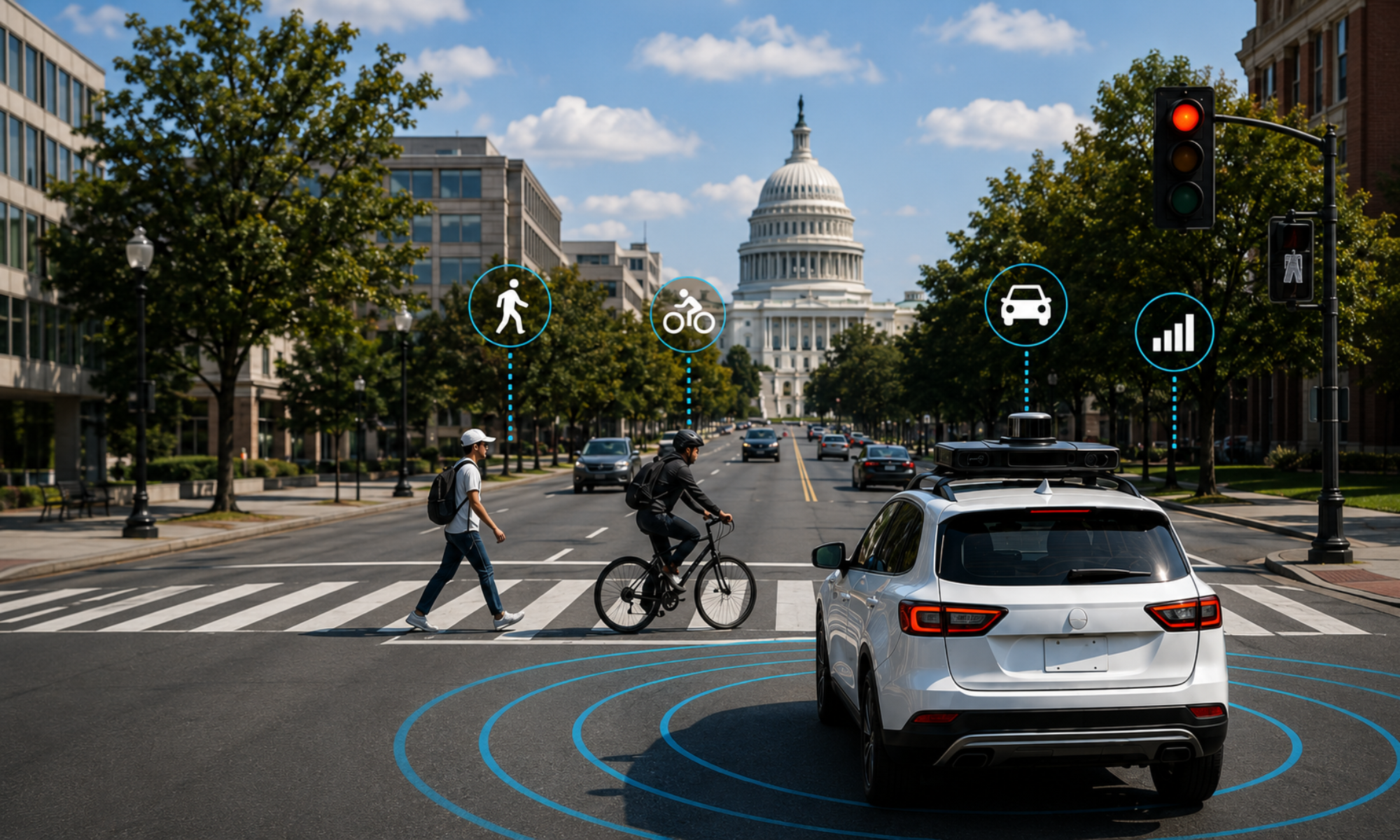
AIWaysion, in partnership with Parsons Corporation, will deploy its Mobile Unit for Sensing Traffic (MUST) to help DDOT independently observe and analyze autonomous vehicle operations in real-world, mixed urban traffic. The Edge AI roadside sensing system uses computer vision to detect and track autonomous vehicles, generate high-resolution trajectory data, and produce configurable traffic behavior analytics. Scheduled to begin in January 2027, the pilot will be part of one of the nation’s first municipal efforts to build an independent, data-driven understanding of how AVs operate on public streets.
The AVO Zone Challenge was designed to identify and pilot innovative solutions that enable DDOT to detect, monitor, and analyze the impact of autonomous vehicle (AV) operations in Washington, DC. Supported by academic partners The George Washington University and the University of Washington, the initiative will help equip DDOT with tools and data insights to better understand how AVs interact within a bustling multimodal transportation environment as emerging transportation technologies continue to evolve.
"US Ignite is proud to support AIWaysion as the winner of the AVO Zone Challenge in DC. Their cutting-edge technology and approach will help the District lead the way for other communities..." Nick Maynard, CEO, US Ignite
“US Ignite is proud to support AIWaysion as the winner of the AVO Zone Challenge in DC,” said Nick Maynard, CEO, US Ignite. “Their cutting-edge technology and approach will help the District lead the way for other communities looking to build capacity and better inform AV policies nationwide. This is an important step toward enhancing safety and innovation in autonomous transportation monitoring.”
"This pilot will provide valuable data to help us understand how autonomous vehicles interact with pedestrians, cyclists, transit users, and motorists in a complex urban environment." Sharon Kershbaum, DDOT Director
“Emerging technology gives us an opportunity not only to better understand how our transportation system is changing, but to make it safer for everyone who uses it,” said DDOT Director Sharon Kershbaum. “This pilot will provide valuable data to help us understand how autonomous vehicles interact with pedestrians, cyclists, transit users, and motorists in a complex urban environment. The decisions we make today will help shape the streets of tomorrow, and our goal is to ensure innovation moves forward with safety at the forefront.”
"The AVO Zone Challenge is a great example of how SWBID can support the district's efforts to ensure AVs drive responsibly so DC's roads are safe for all road users." Zachary Baldwin, Director of Mobility, Data, and Research, SWBID
“AIWaysion is helping the DC Mobility Innovation District take an important step in co-creating safe streets for our residents,” said Zachary Baldwin, Director of Mobility, Data, and Research at SWBID. “The AVO Zone Challenge is a great example of how SWBID can support the district’s efforts to ensure AVs drive responsibly so DC’s roads are safe for all road users.”
To learn more and sign up for updates, visit: www.us-ignite.org/avochallenge/

About
DDOT
The District Department of Transportation’s mission is to equitably deliver a safe, sustainable, and reliable multimodal transportation network for all residents and visitors of the District of Columbia.
AIWaysion
AIWaysion is a transportation technology company pioneering Edge AI smart infrastructure to make transportation systems safer and more efficient. Spun out of the University of Washington STAR Lab and the Pacific Northwest Transportation Consortium (PacTrans) Region 10 University Transportation Center, AIWaysion has advanced and commercialized its award-winning technology through multiple successful USDOT SBIR projects and was featured by the USDOT Volpe Center as a 2024 SBIR success story. Its technology has been deployed at more than 150 locations across 15 states, supporting state, local, and tribal transportation agencies in multimodal traffic monitoring and data collection, roadway safety analysis, adaptive traffic signal control and real-time safety interventions, transportation asset monitoring and management, and connected and automated vehicle (CAV) and vehicle-to-everything (V2X) applications, including innovative projects funded through the USDOT SMART and SS4A programs.
US Ignite
US Ignite works closely with communities, military bases, startups, and researchers to solve their toughest economic development and technology innovation challenges. Operating like a high-tech startup, our nonprofit organization delivers customized results through stakeholder engagement, technical expertise, and targeted tools. In collaboration with our partners, we deliver project outcomes that include breakthrough technologies while creating innovative new jobs, startups, and services. Learn more at us-ignite.org.
Southwest Business Improvement District (SWBID)
The Southwest Business Improvement District (SWBID) is situated in the Southwest quadrant of Washington, DC. It weaves together three distinct areas in the 500 acres south of the National Mall: Federal Center South, housing 26 federal headquarters; the Southwest neighborhood centered around the Waterfront Metrorail Station; and the transformational District Wharf development, located on the waterfront.
The George Washington University
Since its founding in 1821, the George Washington University has prepared graduates to lead with integrity, resilience, and purpose. GW’s School of Engineering and Applied Science (GW Engineering) leverages its location in the heart of the nation’s capital to convene diverse communities of scholars, practitioners, and professionals to responsibly translate innovation to society. This commitment to real-world impact is a hallmark of our nationally and internationally renowned programs, such as the transportation engineering program, where GW Engineering students, faculty, staff, and alumni collaborate to make a lasting impact in D.C. and around the world through safer and smarter urban transportation systems.
Mobility Innovation Center at the University of Washington
The Mobility Innovation Center at the University of Washington brings together researchers, public agencies, industry partners and communities to address today’s most pressing transportation challenges. The center advances collaborative research, emerging technologies and real-world solutions that make mobility safer, more accessible, sustainable and responsive to the needs of people and communities.