
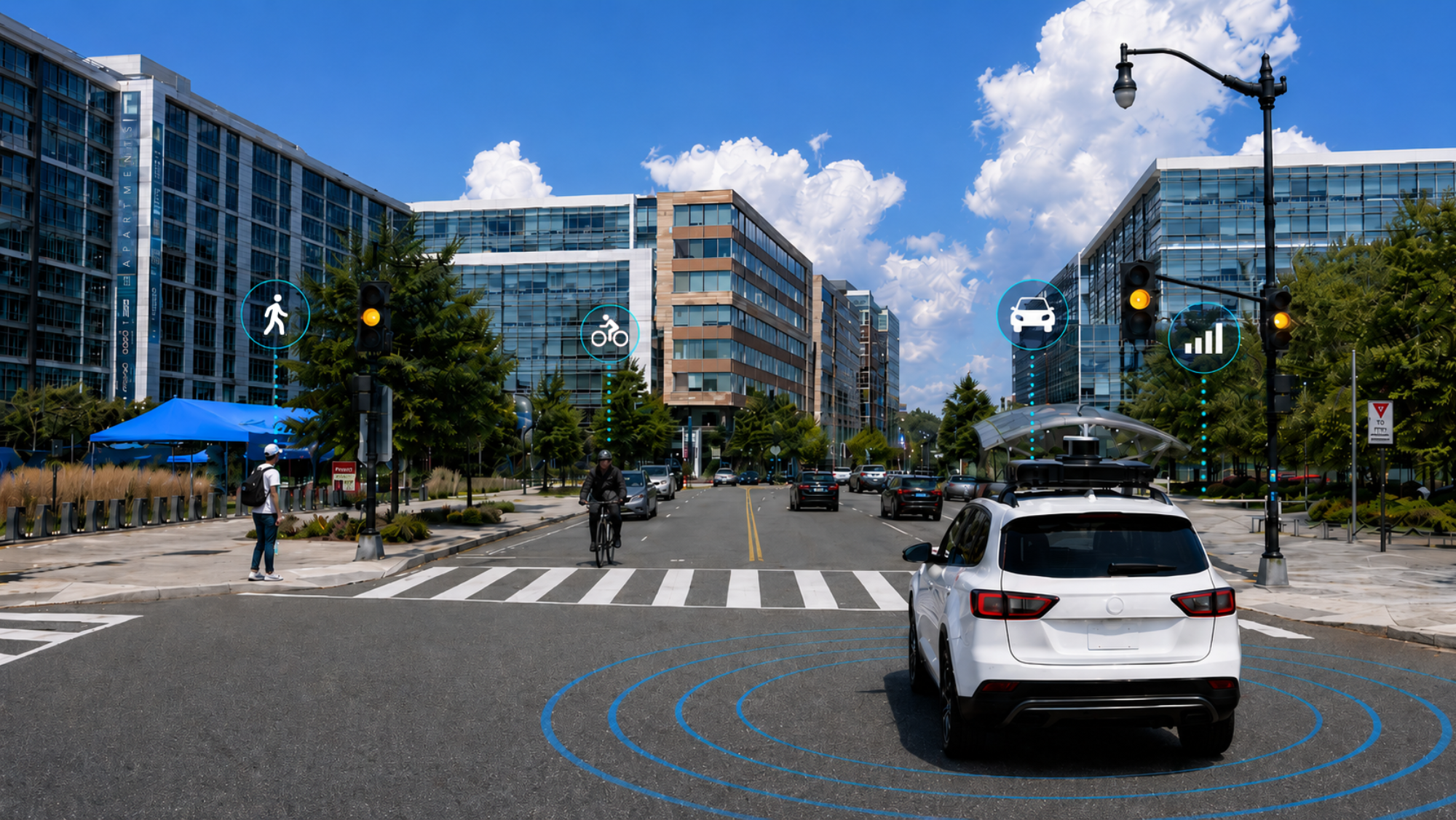
Real-World data for a safer, smarter DC
The District Department of Transportation (DDOT), Southwest Business Improvement District (SWBID), and US Ignite have partnered to launch the Autonomous Vehicle Observation (AVO) Zone Challenge. The challenge provides an innovative way for DC to better understand how AVs operate and in dense, urban environments.
The AVO Zone Challenge seeks an innovative sensing solution capable of detecting and identifying autonomous vehicles (AVs) operating in the District and providing data that supports the observation and analysis of AV fleet operations. The challenge winner will be eligible for a contract award of $50,000 to pilot its technology in DC. The application period for the AVO Zone Challenge has now closed. Thank you to everyone who submitted a proposal and congratulations to AIWaysion for being selected!
Why the AVO Zone Challenge matters
As cutting-edge transportation technologies rapidly evolve, cities must be equipped to better understand how AVs interact within a bustling multimodal transportation environment. DDOT is taking a proactive approach to better understand how these vehicles interact with pedestrians, cyclists, transit users, and other motorists. The AVO Zone Challenge will help establish:
- A data-driven framework for evaluating AV operations
- Increased transparency and informed policymaking
- Greater public accountability
About the Challenge
The AVO Zone Challenge will award a $50,000 contract to AIWaysion. In addition, AIWaysion will pilot their solution in live DC streets for three to six months at two intersections along the M Street SE/SW corridor.
The AVO Zone Challenge calls for innovative solutions that can:
- Detect & Monitor – Independently identify and track AV activity in mixed traffic environments
- Analyze Interactions – Understand how AVs interact with pedestrians, cyclists, vehicles, and infrastructure
- Identify Safety Events – Capture safety-critical events and operational impacts
- Provide Data & Insights – Deliver high-quality, accessible data to support policy, research, and public transparency
Challenge Requirements
The selected sensing solution will provide three key outputs:
- Detect autonomous vehicles at two intersections, 4th and M SW and New Jersey and M SE. The detection cannot rely on in-vehicle transponders or license plate reading.
- The solution must be able to detect three constant, reliable, unambiguous behaviors (e.g., “Right Turns” as opposed “Near Misses”) for all vehicles.
- The proposer will have to describe how quickly their solution can be programmed to detect new behaviors that DDOT identifies during the pilot period. These behaviors will address concerns raised through community engagement.
What’s next?
The application period for the AVO Zone Challenge has now closed. US Ignite, DDOT, and our project partners reviewed the submitted proposals and selected AIWaysion.
Questions regarding the completed application process may be directed to [email protected].

Challenge Sponsors:
The District Department of Transportation’s mission is to equitably deliver a safe, sustainable, and reliable multimodal transportation network for all residents and visitors of the District of Columbia.

The Southwest Business Improvement District (SWBID) is situated in the Southwest quadrant of Washington, DC. It weaves together three distinct areas in the 500 acres south of the National Mall: Federal Center South, housing 26 federal headquarters; the Southwest neighborhood centered around the Waterfront Metrorail Station; and the transformational District Wharf development, located on the waterfront.

US Ignite works closely with communities, military bases, startups, and researchers to solve their toughest economic development and technology innovation challenges. Operating like a high-tech startup, our nonprofit organization delivers customized results through stakeholder engagement, technical expertise, and targeted tools. In collaboration with our partners, we deliver project outcomes that include breakthrough technologies while creating innovative new jobs, startups, and services. Learn more at us-ignite.org.
Academic Partners:
Since its founding in 1821, the George Washington University has prepared graduates to lead with integrity, resilience, and purpose. GW’s School of Engineering and Applied Science (GW Engineering) leverages its location in the heart of the nation’s capital to convene diverse communities of scholars, practitioners, and professionals to responsibly translate innovation to society. This commitment to real-world impact is a hallmark of our nationally and internationally renowned programs, such as the transportation engineering program, where GW Engineering students, faculty, staff, and alumni collaborate to make a lasting impact in D.C. and around the world through safer and smarter urban transportation systems.

The Mobility Innovation Center at the University of Washington brings together researchers, public agencies, industry partners and communities to address today’s most pressing transportation challenges. The center advances collaborative research, emerging technologies and real-world solutions that make mobility safer, more accessible, sustainable and responsive to the needs of people and communities.